
Multimodal Sentiment Analysis
Learn about multimodal sentiment analysis and its applications. This tutorial covers the core concept and a worked example.
Introduction
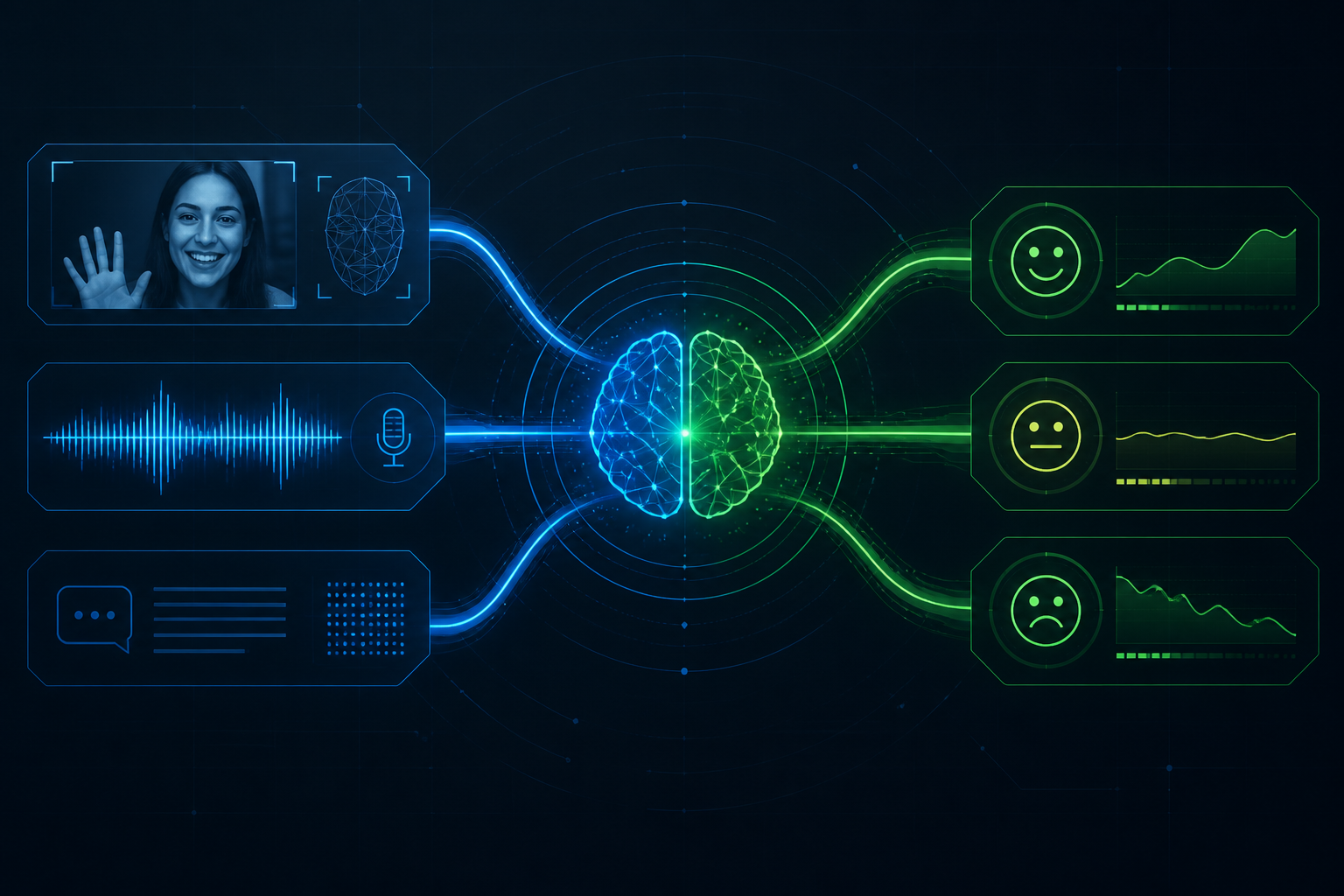
Multimodal sentiment analysis is a subfield of natural language processing (NLP) that involves analyzing sentiment from multiple sources of data, such as text, images, and audio. This field has gained significant attention in recent years due to its potential applications in areas like customer service, marketing, and healthcare.
Context and Importance
In today's digital age, people express their opinions and sentiments through various mediums, including social media, blogs, and review websites. Traditional sentiment analysis methods focus on text data only, which can be limiting in certain scenarios. For instance, a customer may post a negative review with a sarcastic tone, which can be difficult to detect using text-based methods alone. Multimodal sentiment analysis addresses this limitation by incorporating multiple modalities, such as images and audio, to provide a more comprehensive understanding of sentiment.
Core Concept
The core concept of multimodal sentiment analysis involves fusing features from multiple modalities to train a machine learning model. This can be achieved through various techniques, including early fusion, late fusion, and hybrid fusion. Early fusion involves concatenating features from different modalities before training a model, while late fusion involves training separate models for each modality and then combining their outputs. Hybrid fusion combines the benefits of both early and late fusion approaches.
Worked Example
Let's consider a simple example of multimodal sentiment analysis using text and image data. We will use the transformers library to load a pre-trained language model and the torchvision library to load a pre-trained image model.
import torch
from transformers import AutoModel, AutoTokenizer
from torchvision import models
from PIL import Image
from torch.utils.data import Dataset, DataLoader

# Load pre-trained language model and tokenizer
model_name = 'distilbert-base-uncased'
language_model = AutoModel.from_pretrained(model_name)
tokenizer = AutoTokenizer.from_pretrained(model_name)

# Load pre-trained image model
image_model = models.resnet50(pretrained=True)

# Define a custom dataset class
class MultimodalDataset(Dataset):
    def __init__(self, text_data, image_data, labels):
        self.text_data = text_data
        self.image_data = image_data
        self.labels = labels

    def __len__(self):
        return len(self.text_data)

    def __getitem__(self, idx):
        text = self.text_data[idx]
        image = self.image_data[idx]
        label = self.labels[idx]

        # Preprocess text data
        inputs = tokenizer(text, return_tensors='pt')
        text_features = language_model(**inputs).last_hidden_state[:, 0, :]

        # Preprocess image data
        image = Image.fromarray(image)
        image_features = image_model(image)

        return {
            'text_features': text_features,
            'image_features': image_features,
            'label': label
        }

# Create a dataset instance
dataset = MultimodalDataset(text_data, image_data, labels)

# Create a data loader instance
data_loader = DataLoader(dataset, batch_size=32, shuffle=True)

# Train a multimodal sentiment analysis model
for batch in data_loader:
    text_features = batch['text_features']
    image_features = batch['image_features']
    labels = batch['label']

    # Concatenate text and image features
    features = torch.cat((text_features, image_features), dim=1)

    # Train a classifier on the concatenated features
    classifier = torch.nn.Linear(features.shape[1], 2)
    outputs = classifier(features)
    loss = torch.nn.CrossEntropyLoss()(outputs, labels)

    # Backpropagate the loss and update the model parameters
    optimizer = torch.optim.Adam(classifier.parameters(), lr=0.001)
    optimizer.zero_grad()
    loss.backward()
    optimizer.step()
Pitfalls and Challenges
While multimodal sentiment analysis offers several advantages, it also presents some challenges. One of the major pitfalls is the risk of overfitting, especially when dealing with limited amounts of training data. Another challenge is the need for large amounts of annotated data, which can be time-consuming and expensive to obtain. Additionally, multimodal sentiment analysis models can be computationally expensive to train and deploy, requiring significant resources and infrastructure.
What to Read Next
For those interested in learning more about multimodal sentiment analysis, we recommend reading the following papers and tutorials:
- 'Multimodal Sentiment Analysis: A Survey' by S. Poria et al.
- 'Deep Multimodal Learning: A Survey on Recent Advances and Trends' by J. Liu et al.
- 'Multimodal Sentiment Analysis using Transformers and Convolutional Neural Networks' by A. Kumar et al.