Diffusion Image Gen
Diffusion-based image generation is a technique for generating high-quality images. It has applications in computer vision and machine learning.
Introduction to Diffusion-Based Image Generation
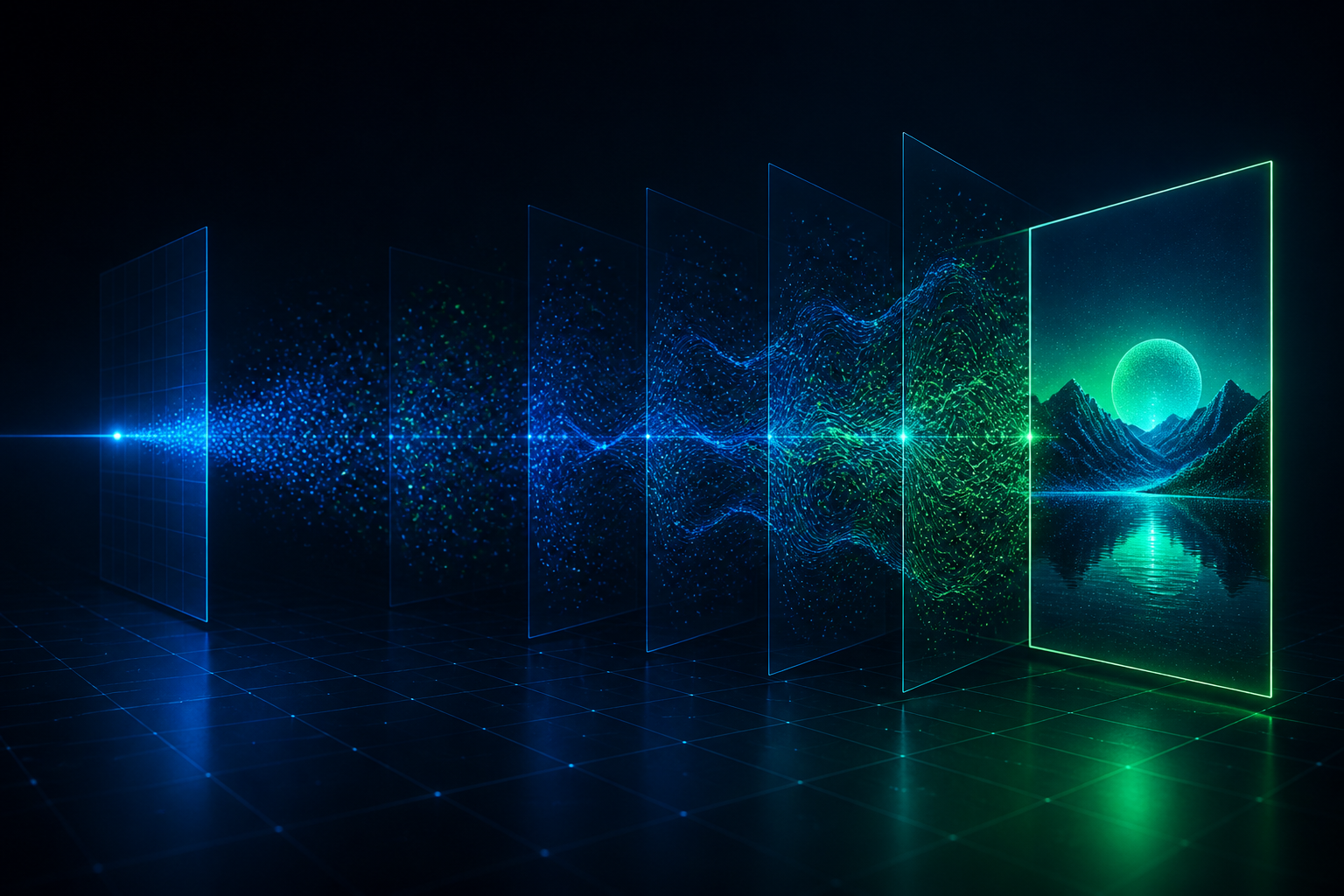
Diffusion-based image generation is a class of deep learning models that have shown great promise in generating high-quality images. The core concept of diffusion-based image generation is to iteratively refine the input noise signal until it converges to a specific image.
Context and Importance
Diffusion-based image generation has applications in computer vision, machine learning, and data augmentation. It can be used to generate new images for training machine learning models, thereby increasing the size of the training dataset and improving the model's performance.
Core Concept
The core concept of diffusion-based image generation is based on the idea of diffusion processes. A diffusion process is a Markov chain that transforms the input noise signal into a series of intermediate representations, with each representation being a refinement of the previous one. The final representation is the generated image.
Worked Example
Here is an example of how to implement a diffusion-based image generation model using PyTorch:
import torch
import torch.nn as nn
import torch.nn.functional as F

class DiffusionModel(nn.Module):
    def __init__(self, num_steps, num_layers, num_channels):
        super(DiffusionModel, self).__init__()
        self.num_steps = num_steps
        self.num_layers = num_layers
        self.num_channels = num_channels
        self.diffusion_layers = nn.ModuleList([self._diffusion_layer() for _ in range(num_layers)])

    def _diffusion_layer(self):
        return nn.Sequential(
            nn.Conv2d(self.num_channels, self.num_channels, kernel_size=3, padding=1),
            nn.ReLU(),
            nn.Conv2d(self.num_channels, self.num_channels, kernel_size=3, padding=1)
        )

    def forward(self, x):
        for i in range(self.num_steps):
            for layer in self.diffusion_layers:
                x = layer(x)
                x = F.relu(x)
        return x

# Initialize the model and the input noise signal
model = DiffusionModel(num_steps=100, num_layers=10, num_channels=3)
input_noise = torch.randn(1, 3, 256, 256)

# Generate the image
generated_image = model(input_noise)
Pitfalls and Challenges
One of the main challenges of diffusion-based image generation is the need for a large number of iterations to converge to a high-quality image. This can be computationally expensive and requires significant resources. Another challenge is the need for a good initialization of the input noise signal, as a poor initialization can lead to poor-quality generated images.
What to Read Next
For more information on diffusion-based image generation, we recommend reading the following papers:
- [1] Ho et al. - Denoising Diffusion Probabilistic Models
- [2] Song et al. - Score-Based Generative Modeling through Stochastic Differential Equations These papers provide a detailed overview of the theory and applications of diffusion-based image generation.
Conclusion
Diffusion-based image generation is a powerful technique for generating high-quality images. It has applications in computer vision, machine learning, and data augmentation. By understanding the core concept and challenges of diffusion-based image generation, we can develop more efficient and effective models for generating high-quality images.